
By The Numbers
The data below provides a snapshot of the state’s population of people with I/DD and older Americans, Home and Community Based Services (HCBS) Waitlists, and the collective impact of the BADN collaboration.
State Disability Prevalence Date
Est Total State Disability Population (%):
17.5%
Est Total State Disability Population (#):
699,500
Est State Prevalence of Developmental Disabilities (%):
State Waiting Lists for Medicaid HCBS
Number of People with IDD on Medicaid HCBS Waitlist:
1,763
Number of People with Autism on Medicaid HCBS Waitlist:
N/A
Number of People who are Seniors and/or have Physical Disabilities on Medicaid HCBS Waitlist:
0
Total Number of People in State on Medicaid HCBS Waitlist:
1,763
State Aging & Disability Network
Number of Area Agencies on Aging/Aging & Disability Resource Centers:
11
Number of Centers for Independent Living:
4
Number of Developmental Disability Regions:
N/A
CITATION FOR COLUMN 1 DATA: The percentage of non-institutionalized males or females with any disability (all ages; 65+), cognitive disability (all ages; 65+), all races, regardless of ethnicity, across all levels of education in the United States. American Community Survey, 2023. Click here to view the source.
CITATION FOR COLUMN 1 DATA: Centers for Disease Control and Prevention. “Developmental Disability, Estimated Prevalence of Developmental Delay, All States, 2021-22. National Environmental Public Health Tracking Network. Click here to view the source.
CITATION FOR COLUMN 2 DATA: Kaiser Family Foundation. “Number of People Waiting for Medicaid Home Care (HCBS), by Target Population and Whether States Screen for Eligibility, 2024”. Click here to view the source.
*Not all state data is available or is N/A
Projects
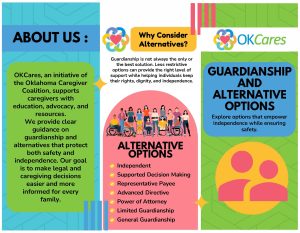
Oklahoma’s State Alliance Team (OK-SAT) is focused on embedding the principles of empowerment throughout the lifespan. Our commitment is to actively ensure that every Oklahoman, particularly those with developmental disabilities and their families, genuinely has their voice heard and respected. This includes a concerted effort to educate our communities on the full spectrum of options beyond traditional guardianship, fostering independence.
Oklahoma’s SAT goals include:

Goal 1
Integrating more futures and goal planning into the Developmental Disabilities Services (DDS) Individual Plan (IP)

Goal 2
Creating an informative website for families, people with developmental disabilities, and professionals to gather information about the alternatives to guardianship. This includes developing an informational training that SAT members can deliver to community partners.

Goal 3
Developing informational materials to better inform DDS and Aging networks on the services and supports each program offers to ensure a well-rounded support system for families.

Goal 4
Developing a self-guided online learning module that covers the continuum of decision-making for families, people with disabilities, and petitioners for guardianship to better inform them on guardianship and alternative options.
Highlights/Milestones Achieved
- Reviewed and suggested changes to the Developmental Disabilities Services (DDS) individual plan (IP) to include more futures and goal planning, along with tips and links for more information. These changes are approved and are being integrated into the IP.
- Creation of an informational website called Continuum of Decision Making: Alternatives to Guardianship. This website provides information and resources about alternatives to guardianship: https://okcares.org/guardianship/
- Begin discussions about potential legislation to improve a petitioner’s knowledge of the alternatives before guardianship and the continuum of decision-making before they petition for guardianship is sought.
- Development of a self-paced online learning module that informs on the continuum of decision-making.
- The SAT team currently includes family members, persons with developmental disabilities, service professionals, and tribal populations.
Testimonials
“As the Director of Legal Empowerment for the Oklahoma Access to Justice Foundation, it is my duty and honor to empower Oklahomans, especially those who are vulnerable and overlooked, to meaningfully participate in the civil justice system. It is integral that this community-individuals with intellectual and developmental disabilities, their caregivers, and loved ones, are aware that they can curate a legal plan tailored to the strengths and limitations of the aging individual without stripping them of all legal rights with a general guardianship. It is also imperative that they are informed of their legal rights and options in plain language and have timely, verified, and vetted resources readily available. It has been a highlight of the past year to enthusiastically participate in this collective of dedicated and impressive organizations, agencies, and families.”
– Tiffani Armendariz, Director of Legal Empowerment, Oklahoma Access to Justice Foundation
“This partnership is a critical lifeline, making aging with intellectual and developmental disabilities in Oklahoma easier to navigate. Together, we are enhancing access to services across the lifespan for individuals and their dedicated caregivers.”
– Talena M. Ford, Community Engagement & Coalitions, Community Living, Aging, and Protective Services, OKDHS
“Oklahoma’s dedication to the Bridging Aging and DD Networks grant is a testament to our commitment to fostering inclusive communities for families across the lifespan. This work has been possible through the exceptional team collaboration we’ve developed. Our diverse group of agencies and passionate individuals has truly come together, breaking down silos and building a cohesive front. By strengthening the ties within our aging and disability networks, we are building a more seamless and supportive system for all Oklahomans, ensuring every individual can age with dignity and access the resources they need.”
– Jenifer Randle, Executive Director, Developmental Disabilities Council of Oklahoma
State Co-Leads
Miranda Hutchison
Programs Administrator
Developmental Disabilities Services (OKDHS)
Jenifer Randle
Executive Director
Developmental Disabilities Council of Oklahoma
State Alliance Teams
Tiffani Armendariz
Director of Legal Empowerment
Oklahoma Access to Justice Foundation
Mat Bisbee
Indian Health Services
Dee Blose
Family Member
Wanda Felty
Assistant Director
Center for Learning and Leadership/UCEDD
Jennifer Jones
Director
Center for Developmental Disabilities, Oklahoma State University
Aaliyah Mobley
Child Welfare Specialist
Child Welfare, OKDHS
Jarvis Rolfe
Person with Lived Experience
Marshell SourJohn
AARP
Samantha Basave
Statewide Sibling Support Coordinator
Sooner SUCCESS
David Blose
Family Member
Amanda Dirmeyer
CEO
Daily Living Centers
Talena Ford
Community Engagement & Coalitions
Community Living, Aging, and Protective Services, OKDHS
Kimberly Krise
Waitlist Manager
Liberty of Oklahoma
Jennifer Robinson
Planning & Grants Director
Developmental Disabilities Council of Oklahoma
Ruth Rolfe
Family Member
Jennifer Tall Bear
Community Justice Worker
Oklahoma Indian Legal Services